
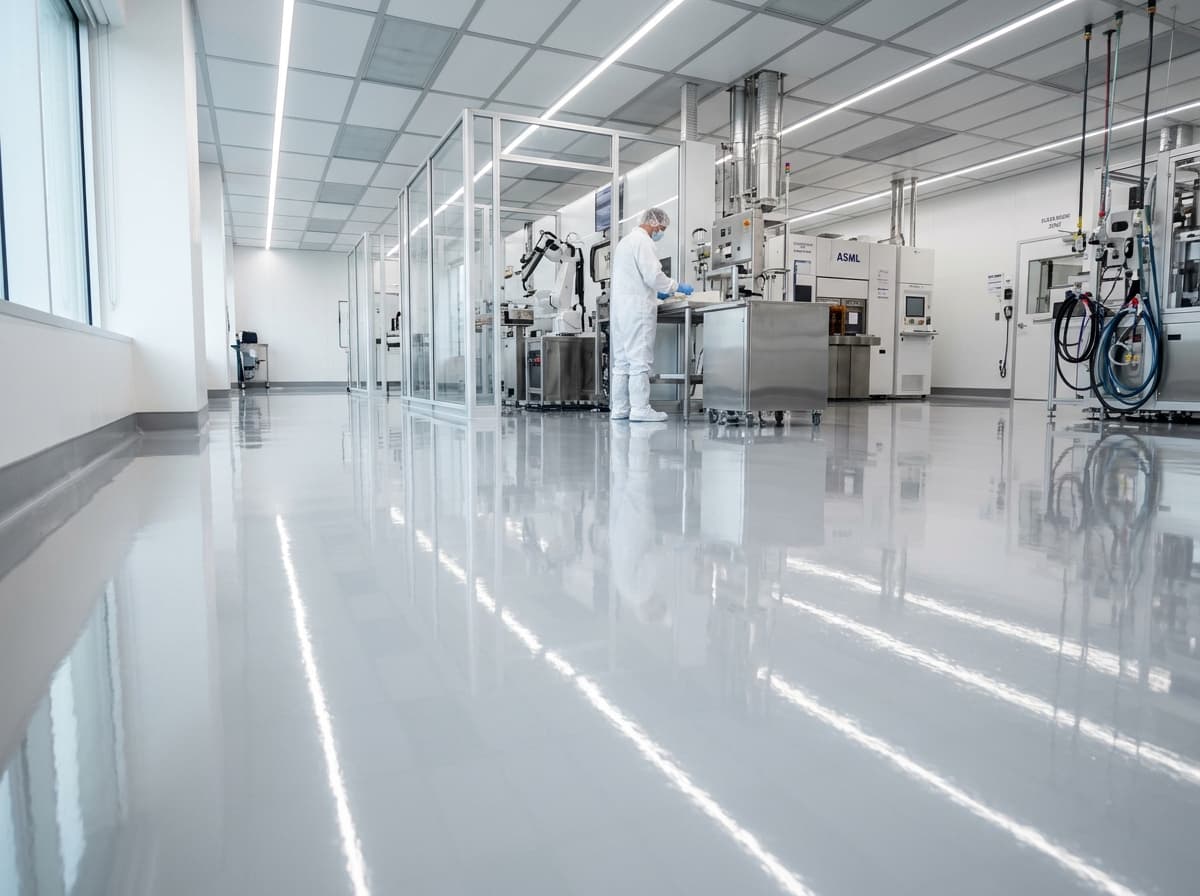
Electrostatic Discharge (ESD) flooring safely drains static electricity generated by walking personnel and rolling equipment to ground before it can destroy sensitive microchips or ignite flammable solvents. Applied as a 2mm-3mm self-leveling conductive epoxy with embedded copper tape grid networks connected to earth ground, it achieves electrical resistance between 1.0 x 10⁴ and 1.0 x 10⁹ Ohms compliant with ANSI/ESD S20.20.
Key Engineering Takeaways
- Static charges as low as 100 volts (undetectable by human touch) can permanently destroy microprocessors, sensors, and PCB boards.
- ESD systems incorporate a conductive carbon primer and brass/copper tape grid connected to building earthing pits.
- Conductive floors (10⁴ – 10⁶ Ω) are specified for volatile explosive solvent zones; Dissipative floors (10⁶ – 10⁹ Ω) for electronics assembly.
- KB Flooring BD provides certified megohmmeter point-to-ground resistance testing reports upon project handover.
1. The Invisible Threat of Electrostatic Discharge
In Bangladesh's booming electronics manufacturing hubs—assembling smartphones, LED televisions, automotive wiring harnesses, and precision printed circuit boards (PCBs)—electrostatic discharge is a silent multi-million dollar threat.
When workers walk across standard floors, friction generates static body voltage up to 20,000 volts. Touching a microchip releases this charge instantly, causing catastrophic gate dielectric breakdown or latent defects that fail after customer delivery.
2. The Anatomy of an ESD Conductive Floor System
An engineered ESD floor is a sophisticated multi-tier electrical grounding system:
1. Insulating Base Primer: Seals the concrete slab and provides uniform electrical isolation.
2. Self-Adhesive Copper Tape Grid: A continuous grid of conductive copper tape (10mm to 12mm wide) is laid across the floor at 3m x 3m intervals and connected to dedicated building earth grounding electrodes.
3. Conductive Black Carbon Primer: A specialized resin infused with conductive carbon particles coats the entire floor, ensuring uniform electrical conductivity from every square millimeter into the copper grid.
4. ESD Self-Leveling Topcoat: Formulated with conductive carbon nanotubes and conductive pigments, this layer allows static charges to bleed vertically downward into the grounding plane while presenting a clean, mirror-gloss aesthetic.
Frequently Asked Questions
How often should an ESD floor be tested for electrical resistance?
In compliance with ANSI/ESD S20.20, facilities should conduct monthly point-to-point and point-to-ground megohmmeter audits using calibrated 5-pound weighted circular electrodes.
Can standard floor wax or cleaners be used on an ESD floor?
Never. Standard waxes leave an insulating silicone film that blocks electrical static dissipation. ESD floors must only be cleaned with specialized conductive, residue-free neutral detergents.